The Firmament: A Real Dome, and the Throne Above It
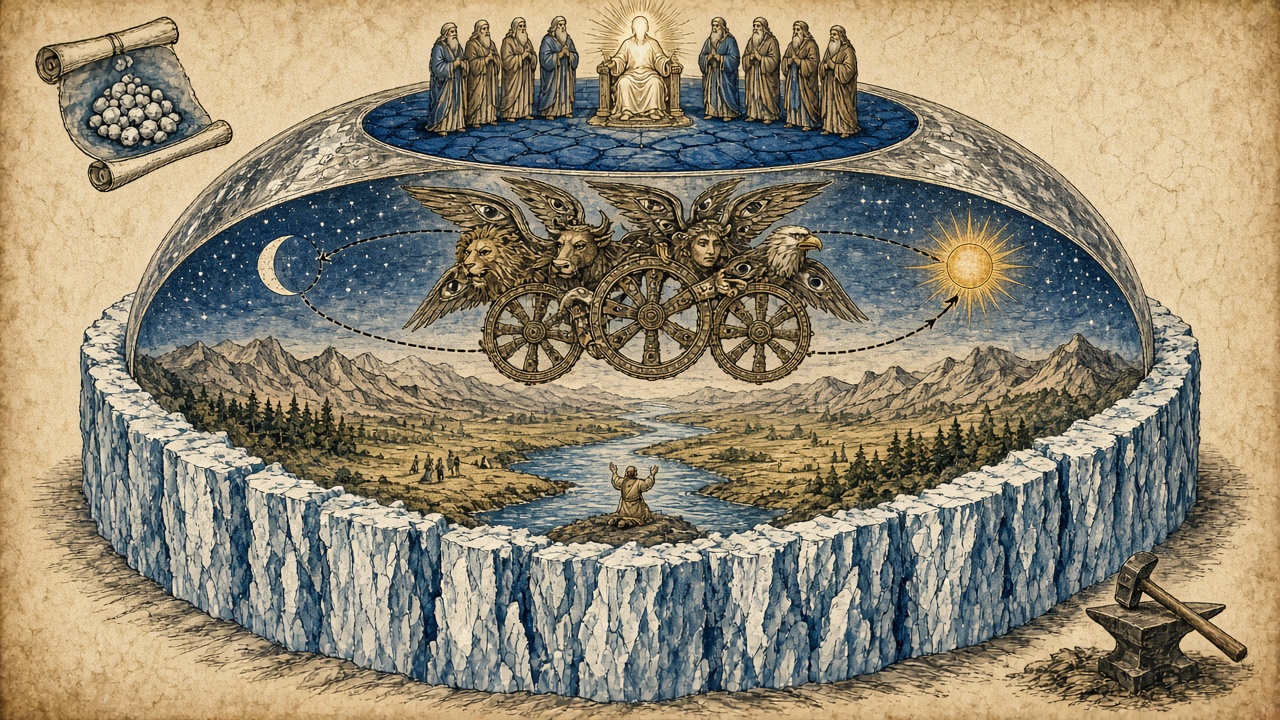
I believe the biblical authors understood the firmament to be a real, physical structure. I do not read it as a metaphor or an allegory, and I think the text, read on its own terms, does not allow that reading. Here is the case as I see it.
1. What the word means
The Hebrew word in Genesis 1 is raqia. It comes from the verb raqa, which means to beat out or hammer flat. It is the word used for gold beaten into thin sheets (Exodus 39:3) and for metal plates hammered out to overlay an object (Isaiah 40:19). The Septuagint translated it stereoma, and the Latin Vulgate used firmamentum, which is where our word "firmament" comes from. Both mean something firm and solid. The earliest translators heard a solid vault in the word, and I think we should hear it too.
2. What it was made to do
"And God said, Let there be a firmament in the midst of the waters, and let it divide the waters from the waters. And God made the firmament, and divided the waters which were under the firmament from the waters which were above the firmament: and it was so" (Genesis 1:6-7). The passage is specific. There are waters below and waters above, and the firmament stands between them as a divider. God then calls it Heaven (1:8), and on the fourth day he sets the sun, moon and stars "in the firmament of the heaven" (1:14-17). It is a physical barrier that holds things in place and has the lights fixed in it.
3. The rest of the Old Testament speaks the same way
Psalm 148:4 says, "Praise him, ye heavens of heavens, and ye waters that be above the heavens." The psalmist commands the waters above the heavens to praise the Lord. If there were no such waters, the command would be empty, so I take it that he believed they were there.
Job describes the same structure. God "bindeth up the waters in his thick clouds; and the cloud is not rent under them" (Job 26:8). He "hath compassed the waters with bounds, until the day and night come to an end" (Job 26:10). Elihu asks Job, "Hast thou with him spread out the sky, which is strong, and as a molten looking glass?" (Job 37:18). The sky is called strong, like a mirror of cast metal. That is a description of something hard and polished.
4. What the prophets saw above them
Ezekiel gives the clearest picture. In his first vision, "the likeness of the firmament upon the heads of the living creatures was as the colour of the terrible crystal, stretched forth over their heads above" (Ezekiel 1:22). Above that firmament was "the likeness of a throne, as the appearance of a sapphire stone: and upon the likeness of the throne was the likeness as the appearance of a man above upon it" (1:26). In chapter 10 he sees it again. The cherubim are beneath the firmament, and above it is "as it were a sapphire stone, as the appearance of the likeness of a throne" (10:1).
Moses had seen this long before. In Exodus 24:10, Moses, Aaron, Nadab, Abihu and seventy of the elders "saw the God of Israel: and there was under his feet as it were a paved work of a sapphire stone, and as it were the body of heaven in his clearness." The pavement under God's feet is described as "the body of heaven." Two witnesses, centuries apart, looked up and described the same blue-stone floor with the throne over it.
5. How it looks from the throne
Isaiah gives us the view from above: "It is he that sitteth upon the circle of the earth, and the inhabitants thereof are as grasshoppers; that stretcheth out the heavens as a curtain, and spreadeth them out as a tent to dwell in" (Isaiah 40:22). God is seated above the circle of the earth, and from there people look like grasshoppers. He stretches out the heavens like a curtain and spreads them like a tent. The language is architectural. It describes a covering and the One enthroned over it. Isaiah 66:1 says it again: "The heaven is my throne, and the earth is my footstool."
6. The same throne from beginning to end
If the firmament is set in place at creation, the end of the story should show it undone, and I believe it does. In Revelation 6:14, "the heaven departed as a scroll when it is rolled together." A scroll can only be rolled back if there was something stretched out to roll. In Revelation 16:21, "there fell upon men a great hail out of heaven, every stone about the weight of a talent." A talent was roughly a hundred pounds. I read this as the firmament undone, with the stored judgment God asks about in Job 38:22-23 finally released: "Hast thou entered into the treasures of the snow? or hast thou seen the treasures of the hail, which I have reserved against the time of trouble, against the day of battle and war?"
7. Why this matters
We are not helped by trimming the text to fit the way we already think about the world. The authors wrote what they believed, and God inspired what they wrote. Taken together, the passages give one consistent picture. A solid vault was hammered out on the second day, it divides the waters, the lights are set in it, and the throne of God rests above it. In the end it is rolled back and opened. The One who hammered it out is the One who will roll it up, and the picture hangs together from Genesis to Revelation.